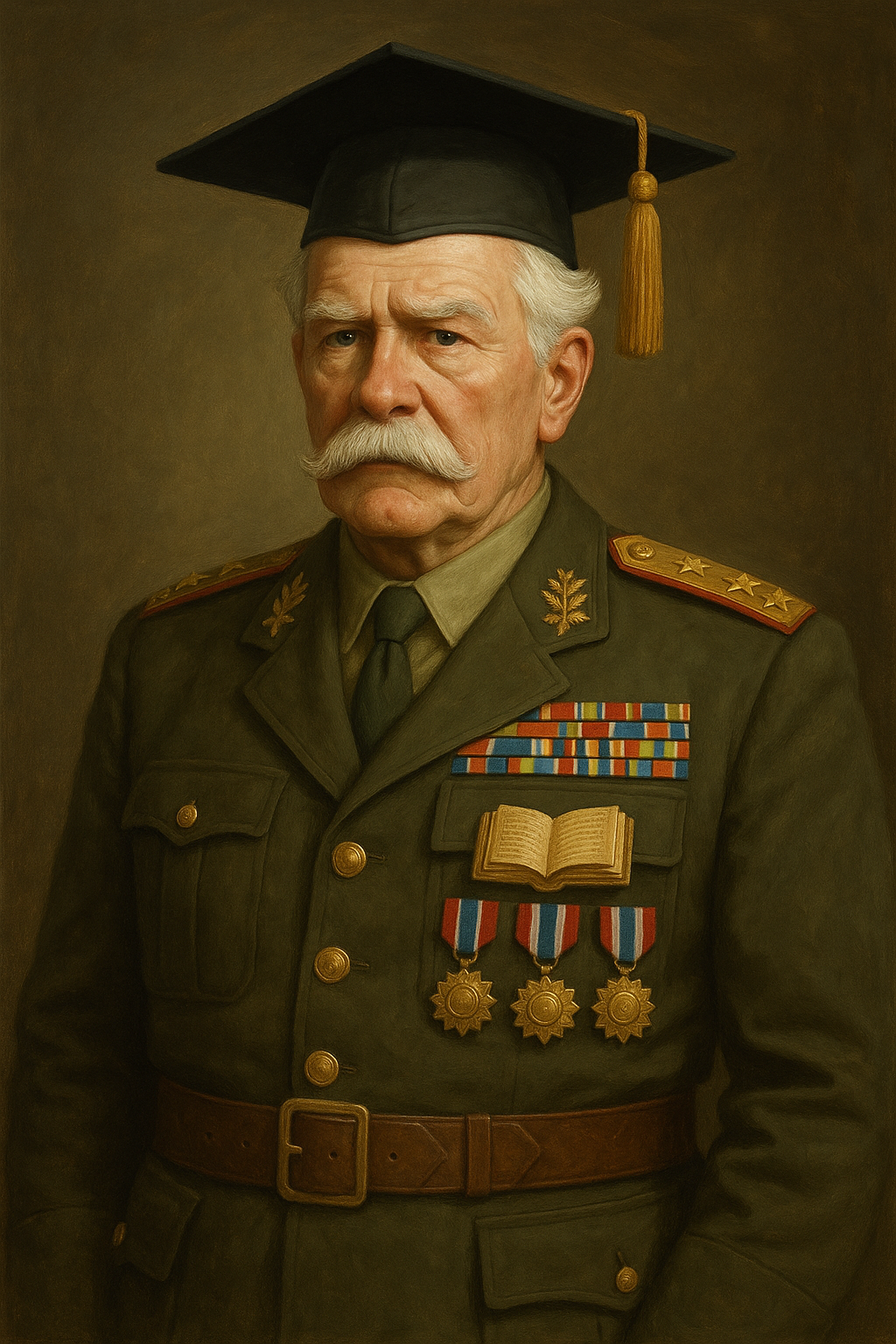
General Education (retired) was once Supreme Commander of the Liberal Arts, Defender of the Elective, Keeper of the Broadly Transferable Skill Set. In his prime he strode campuses in a cape of library curtains carrying a globe and a small stack of unread but morally improving books. Wherever he marched, students learned at least a little about history, science, literature, and just enough philosophy to become unbearable at dinner.
He commanded the legendary Four Divisions: the Infantry of Composition, armed with pointed thesis statements; the Armored Humanities, whose treads crushed false dichotomies; the Cavalry of Natural Science, galloping on Evidence, Replication, and his personal steed, Grant Proposal Deadline; and, descending from the skies, the Special Forces of Critical Thinking, capable of landing anywhere and asking, “What assumptions underlie this claim?”
For a time he was happy and relevant. Governments plagiarized him in speeches. Parents saw him as a path to enlightened citizenship. Students resented him, then years later quoted him unexpectedly in hardware stores. Under his reign, citizens could locate countries on maps, distinguish correlation from causation, and cultivate their identities as something larger and more important than the larval stage of a worker.
Then came the Long Counteroffensive.
First came the Ministers of Immediate Employability. They asked, with terrible politeness, whether students truly needed ethics when forklift certification was available. Then came the Ministers of Efficiency, who believed all knowledge should fit in cells A1 through H27. They attacked the old fortresses one by one. Philosophy was told to justify itself in quarterly metrics. History was asked what software it ran. Literature was informed that feelings were not scalable.
General Education fought bravely. At the Battle of Curriculum Review he held the line for three days sustained on only the fumes of a whiteboard marker and a passage from Marcus Aurelius' Meditations. At the Siege of Budget Season he survived on principle and a tattered copy of The Art of War. During the terrible Night of a Thousand Strategic Plans, he personally rescued Anthropology from a thousand-slide PowerPoint deck.
But every year another banner fell. Breadth requirements became “optional pathways.” Civic literacy sank under the waves as “soft skills.” He watched as students forgot how to ask where meaning comes from, or how power is distributed, or what there is to human life beyond making a rich person slightly richer and paying debt.
Yet all is not lost. Sometimes a weary student, exhausted by training modules and corporate jargon, searches for a thing they have been denied an ability to name. They click a page on astronomy, or poetry, or why democracies fail. They read for twenty minutes longer than intended. A small light returns to their eyes.
Then, somewhere, old General Education straightens his shoulders, adjusts his curtain-cape, and walks.